
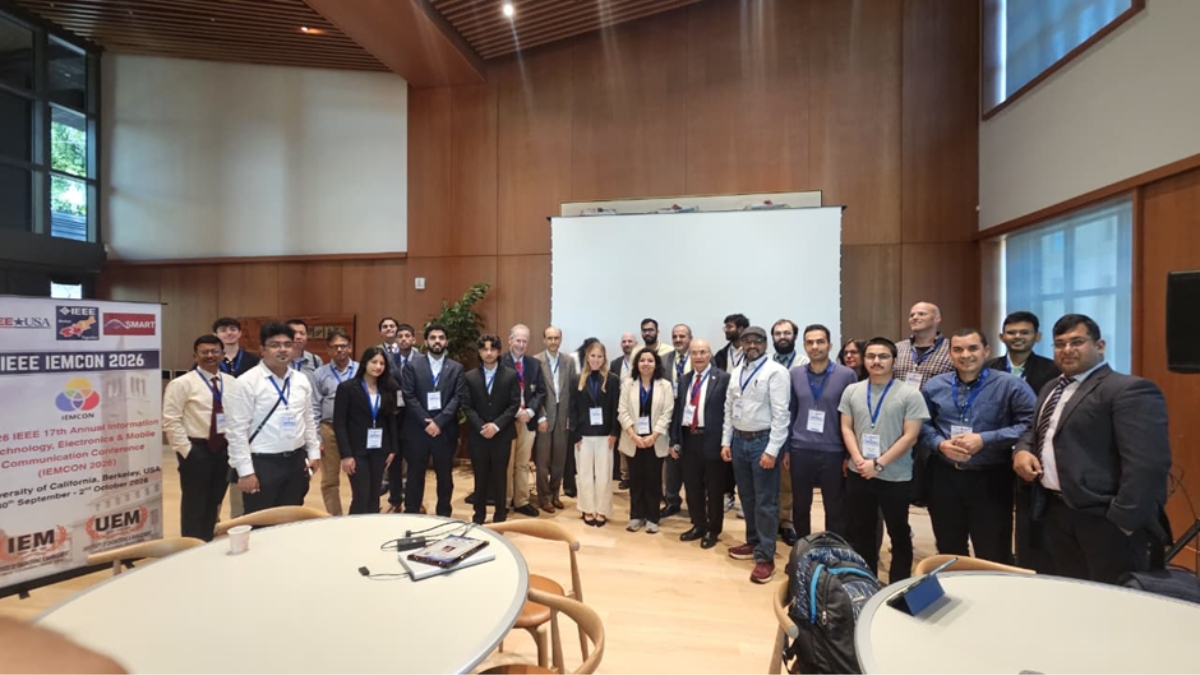
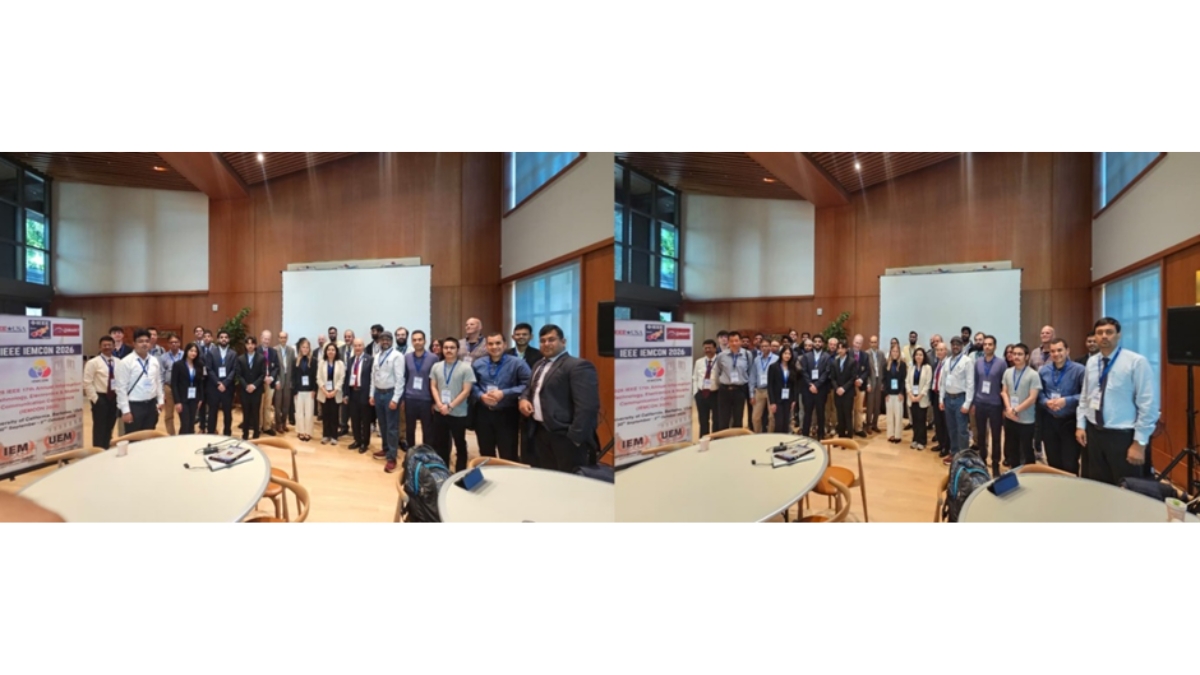
New Delhi [India], October 1: Researchers, academics, technology professionals, industry experts, students and innovators from across the world have come together at the University of California, Berkeley, for the 2026 IEEE 17th Annual Information Technology, Electronics, and Mobile Communication Conference (IEEE IEMCON 2026), being organised by the IEM–UEM Group from Kolkata and Jaipur.
The three-day international conference, being held from September 30 to October 2, 2026, is an important international academic initiative of the Institute of Engineering & Management (IEM), Kolkata, and University of Engineering & Management (UEM), Kolkata and Jaipur.
For the IEM–UEM Group, the Berkeley conference is also about taking Indian researchers and students closer to the global research community. Through the platform, thousands of Indian researchers, students and faculty members are expected to benefit directly and indirectly from exposure to international research, emerging technologies, global academic networks, keynote lectures, research collaborations and ideas emerging from the conference.
IEEE IEMCON 2026 brings researchers and professionals together to present their latest work and exchange ideas across fast-developing areas such as Artificial Intelligence (AI), Information Technology, Electronics, Mobile Communication, Cybersecurity, Internet of Things (IoT), Big Data, Cloud Computing, Wireless Communication and Human–Device Interaction.
Taking Indian academia to global research platforms
The decision to organise IEEE IEMCON 2026 at Berkeley reflects the IEM–UEM Group’s continuing effort to build stronger links between Indian students and researchers and the international academic and technology community.
For Indian researchers, the conference provides an opportunity to interact with internationally recognised scientists, professors, technology professionals and industry researchers, while getting a closer look at research directions emerging from universities and technology organisations across the world.
The knowledge and international connections developed through the conference are also expected to make their way back to classrooms, laboratories, research groups and innovation initiatives in India. In turn, this could extend the benefits of the conference to thousands of students, researchers and faculty members.
14 technical sessions on emerging technologies
The three-day programme features 14 technical sessions covering subjects including Artificial Intelligence; Applications of AI; IoT and Big Data; Advanced Mobile Communication and AI; AI and Cybersecurity; Cloud and Big Data; Cybersecurity and Blockchain; AI and Consumer Electronics; AI and Wireless Technologies; Consumer Electronics and Human–Device Interaction; Communication and AI; and other AI-driven technologies.
The inaugural session on September 30 was formally initiated by Prof. (Dr.) Rajashree Paul, Technical Co-Chair. Welcoming the delegates, she highlighted the importance of international collaboration and technological innovation in addressing emerging global challenges.
The session was followed by addresses from the conference leadership — Prof. (Dr.) Son Vuong, University of British Columbia, General Co-Chair; Dr. Mohammad-Reza Alam, University of California, Berkeley, General Co-Chair; Prof. (Dr.) Phillip Bradford, University of Connecticut, Technical Co-Chair; and Prof. (Dr.) Charles Rubenstein, Pratt Institute, USA, Financial Chair.
The speakers highlighted the growing importance of interdisciplinary research, emerging technologies and international academic collaboration in advancing engineering and computing.
“Creating global opportunities for Indian students and researchers”
Commenting on the significance of the initiative, Prof. Satyajit Chakrabarti, Vice Chancellor of UEM Kolkata, said:
“One of the major objectives of the IEM–UEM Group is to create opportunities for Indian students, faculty members, and researchers to participate in the global knowledge and innovation ecosystem. By organising IEEE IEMCON at Berkeley, we are creating a bridge between our academic community in India and some of the world’s leading researchers, universities, and technology organisations. The knowledge, collaborations, and international exposure generated through this conference can ultimately benefit thousands of Indian students, researchers, and faculty members. We want our young researchers not only to learn about the technologies shaping the future, but also to participate actively in creating that future.”
International experts headline keynote programme
A major attraction of IEEE IEMCON 2026 is its keynote programme, which features experts from leading academic institutions and technology organisations.
On September 30, Thomas Kehler, CEO of CrowdSmart and former CEO of IntelliCorp and CEO Connect, delivered a keynote on “Rebuilding the Artificial Neuron for a Distributed Intelligence Reasoning System.”
This was followed by Prof. Hamid Jafarkhani of the University of California, Irvine, who addressed “UAV Wireless Communication and Sensing Networks.”
On October 1, Dr. Yan Liu of the University of Southern California is scheduled to speak on “Frontiers of Physics-Informed Foundational Models for Time Series.”
Anna Lisa Gentile, Senior Research Scientist at IBM, will deliver another keynote titled “From Conversation to Memory: Consolidating What Agents Learn About Us.”
The final day will feature Dr. Robert W. Heath Jr. of the University of California, San Diego, speaking on “The Tri-Hybrid MIMO Architecture for 6G.”
The keynote programme will conclude with Dr. Yuhong Liu of Santa Clara University, California, speaking on “Trustworthy AI.”
Researchers from across countries join the programme
The conference programme features research contributions from academics, students, researchers and professionals affiliated with universities, research institutions and technology companies across several countries.
The research being presented covers a wide range of areas, including large language models, machine learning, autonomous systems, AI-enabled healthcare, cybersecurity, blockchain, wireless networks, edge and cloud computing, multi-agent systems, consumer electronics, human–computer interaction and next-generation communication technologies.
The technical programme includes contributions from researchers associated with institutions and organisations including Indian Institute of Technology Madras, University of California campuses, Arizona State University, George Mason University, Marshall University, Trinity Western University, PayPal, NVIDIA, Roku and several other academic and industry organisations.
Researchers participating in the programme represent countries including the United States, India, Canada, Saudi Arabia, Germany, the Netherlands, Brazil, Pakistan and Taiwan, among others.
Selective international research platform
The paper acceptance rate for IEEE IEMCON 2026 is 34.6%, reflecting the conference’s selective peer-review process.
IEEE IEMCON 2026 continues through October 2, 2026, with technical presentations, keynote addresses, research discussions and opportunities for international academic and industry collaboration.
Through initiatives such as IEEE IEMCON, the IEM–UEM Group, with its institutions in Kolkata and Jaipur, seeks to expand international research engagement and provide Indian students, researchers and faculty members with greater access to global developments in science, engineering and emerging technologies.
If you object to the content of this press release, please notify us at pr.error.rectification@gmail.com. We will respond and rectify the situation within 24 hours.
(The article has been published through a syndicated feed. Except for the headline, the content has been published verbatim. Liability lies with original publisher.)