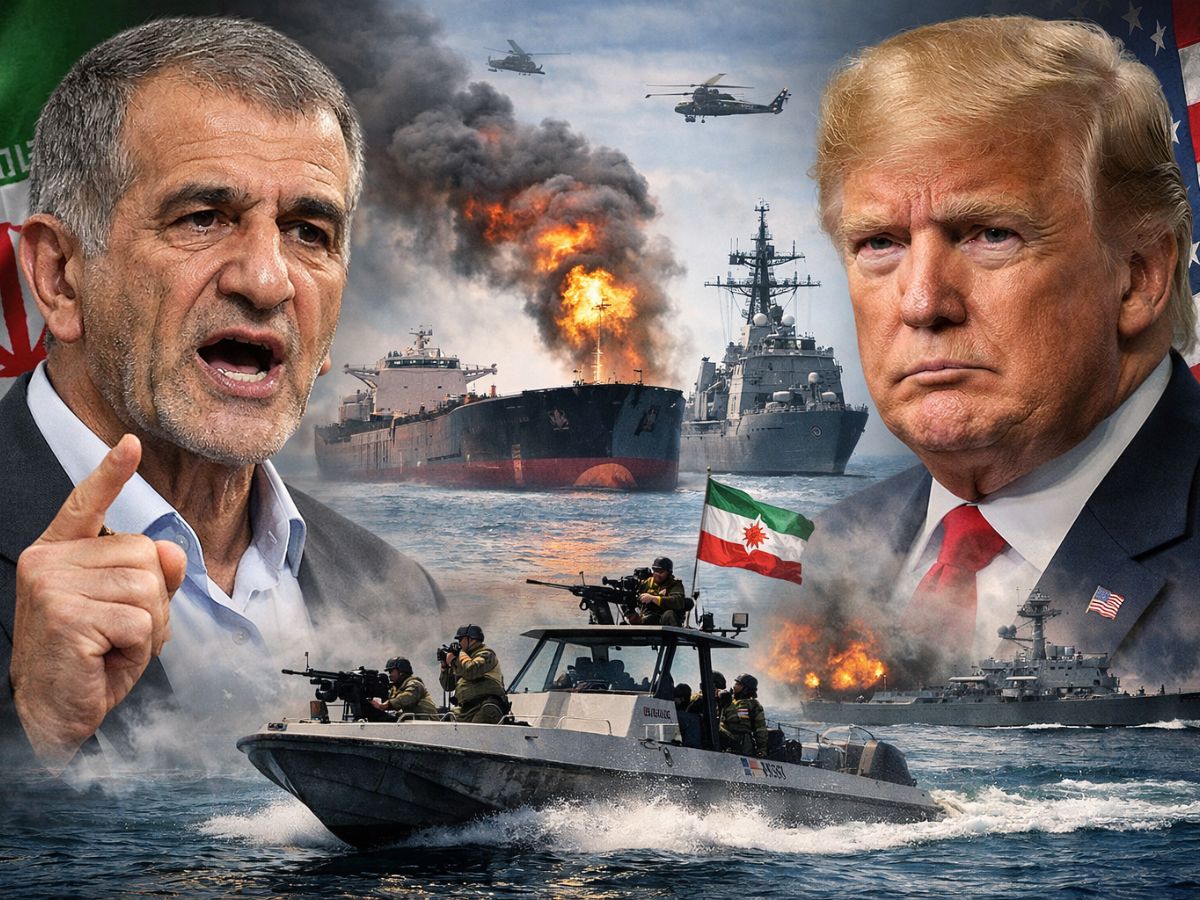
Iran blocks tankers in the Strait of Hormuz as tensions with the US rise. [Photo: AI]
Tensions between Iran and the United States have escalated sharply, triggering both a maritime crisis and a diplomatic standoff. The Strait of Hormuz, a key global oil route, has seen severe disruption, with tankers being stopped and shipping activity slowing drastically.
At the same time, Iran’s leadership has openly criticised US demands over its nuclear programme. These parallel developments highlight how military, economic, and political tensions are now deeply interconnected.
The crisis has already begun affecting global oil markets and supply chains. With talks still ongoing but unresolved, uncertainty continues to grow. The situation remains volatile and closely watched worldwide.
Iranian President Masoud Pezeshkian has strongly criticised Donald Trump over US restrictions on Iran’s nuclear programme. He questioned Washington’s authority to impose such limitations.
Speaking publicly, Pezeshkian said, “Trump says Iran cannot make use of its nuclear rights, but doesn’t say for what crime. Who is he to deprive a nation of its rights?”
His remarks reflect growing frustration in Tehran over US pressure. The statement also signals Iran’s refusal to accept external limits on its technological capabilities. The comments come at a sensitive time as negotiations continue. They may further complicate diplomatic progress between the two sides.
The dispute centres around Iran’s right to develop and use nuclear technology. The United States has long argued that Iran must limit its programme to prevent weaponisation. However, Iran insists its nuclear activities are for peaceful purposes and fall within international agreements.
Tehran maintains that no country has the authority to deny it access to nuclear technology. The disagreement has remained a major sticking point in negotiations. It has also shaped the broader conflict between the two nations.
Recent talks have failed to bridge this gap, keeping tensions high. The issue continues to dominate diplomatic discussions and policy decisions. Without compromise, the nuclear dispute could further escalate the crisis.
Iran’s military has tightened its grip on the Strait of Hormuz, preventing tankers from transiting the route. Reports confirm that vessels attempting to pass have been turned back. This move signals stricter enforcement of Iran’s maritime control.
The strait is one of the world’s busiest oil corridors, making any disruption highly significant. Shipping companies now face delays and safety concerns. Many vessels are waiting outside or rerouting to avoid confrontation.
This development has further reduced maritime traffic in the region. It also increases the risk of escalation at sea. The situation continues to evolve with no immediate resolution.
Diplomatic talks between Iran and the United States are ongoing but remain inconclusive. Both sides have acknowledged some progress, but major differences persist.
A temporary ceasefire is nearing its expiry, adding urgency to negotiations. Key disagreements, especially over nuclear policy, continue to block a final agreement.
Iranian officials have indicated that discussions are still far from completion. The lack of clarity has prolonged uncertainty in the region. Global powers are monitoring the situation closely. The outcome of these talks will shape the next phase of the conflict.
Iran has argued that US and Israeli actions violate international law, including the UN Charter and nuclear agreements. Officials claim there is no legal basis for restricting Iran’s nuclear programme.
Tehran also maintains that it has not breached its obligations under global nuclear treaties. These claims have sparked debate in international diplomatic circles.
Critics warn that such positions could escalate tensions further. Supporters argue Iran is asserting its sovereignty. The legal dispute adds complexity to already difficult negotiations. It also raises concerns about global security and compliance with international norms.
Shipping activity in the Strait of Hormuz has dropped to minimal levels amid the crisis. Reports suggest that vessel movement has nearly stopped due to safety risks and military presence.
In normal conditions, the Strait handles a large volume of global oil shipments daily. However, current restrictions have created a bottleneck. Ships are either waiting outside or avoiding the route altogether.
This slowdown has disrupted global logistics networks. It has also increased uncertainty for shipping companies. The strait remains under tight control, limiting free movement.
Iran continues to defend its actions as necessary for protecting national sovereignty and security. Officials argue that controlling access to the strait is within their rights, given the current conflict.
At the same time, international stakeholders have raised concerns about freedom of navigation. The situation has triggered debates over maritime law and global trade norms.
Countries dependent on oil imports are particularly worried about prolonged disruption. The issue has drawn attention from global institutions and policymakers. The legal and political dimensions of the crisis remain unresolved.
The disruption in the Strait of Hormuz has had immediate effects on global trade. Around 20% of the world’s oil passes through this route, making it a critical chokepoint.
Delays in shipments have increased freight and insurance costs. Oil prices have shown volatility due to uncertainty in supply. Supply chains across industries are facing disruptions.
Shipping companies are exploring alternative routes, but options remain limited. Longer routes mean higher operational costs. The economic impact could grow if the situation continues. Markets remain highly sensitive to developments.
The future of the crisis depends on diplomatic progress between Iran and the United States. Both sides remain firm in their positions, with no immediate breakthrough.
Experts warn that without compromise, tensions could escalate further. This may lead to prolonged disruption in global shipping and energy markets. The expiry of the ceasefire could also trigger new developments.
Diplomatic efforts are ongoing, but uncertainty remains high. A resolution could restore normal shipping operations. Until then, the Strait of Hormuz will remain a focal point of global concern.
North Korean internet was hit by DDoS cyberattack, network monitoring firm says
By Brenda Goh SEOUL, Oct 23 (Reuters) - A cyberattack likely caused intermittent internet outages…
GM cancels deal with new US rare-earth magnet plant, documents say
By Eric Onstad LONDON, Oct 22 (Reuters) - General Motors, the biggest customer of a…
Trump criticises LeBron James for showing 'disrespect' during US national anthem
VIDEO SHOWS: US PRESIDENT, DONALD TRUMP, ARRIVING FOR RALLY / SOUNDBITES FROM TRUMP / ATTENDEES…